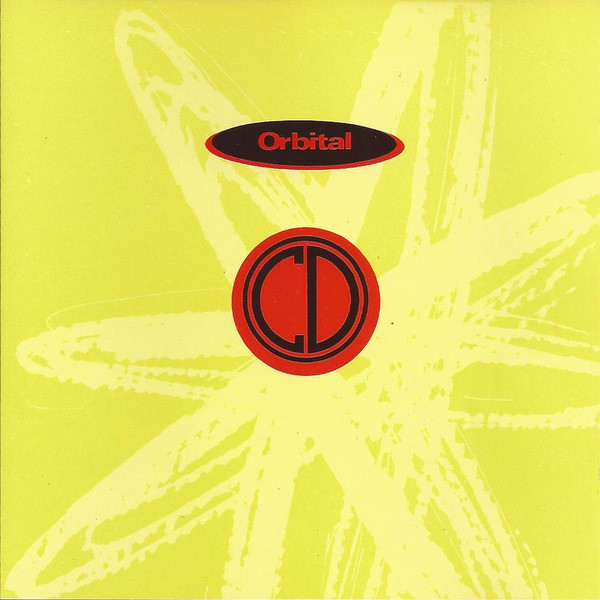
The Green Album – Orbital – Released 30th September 1991, FFRR
Commonly referred to as the Green Album due to its distinctive lime green cover, the debut album from Orbital was first released on Pete Tong’s FFRR label back in 1991.
Though clearly showing its age in places, its rendered timeless thanks to the inclusion the Hartnoll brothers’ two most famous and best-loved tracks, Belfast and Chime.
With the launch of today’s re-issue, including a new 4-disc vinyl album packed with remixes and rarities, we’re given the perfect excuse to revisit the album which started it all by leaping into the nearest temporal anomalie…
Where Time Becomes A Loop
Cause And Effect remains one of my favourite Star Trek episodes. It sees Picard and crew caught in a time loop repeating the same day over and over like Groundhog Day.
It’s one of the best TNG episodes, with a cameo from Kelsey Grammar and has the best cold open of any TV episode ever made.
Right from the get-go we’re at red alert, staring in shock as the Enterprise explodes right before the credits even roll.
Wtf?
I felt that exact same sense of surprise and excitement the first time I listened to the Green Album, which famously opens with a sample from that episode as the mighty Lieutenant Worf discusses the theory of the Moebius, “where time becomes a loop…”

While I was already familiar with some of the tracks on this debut, my first Orbital album was Snivilisation. I graduated to this one next since it made sense to go back and start chronologically.
Before I’d heard even a single note I was on board because Lieutenant Worf is the man.
What follows is a streamlined slice of 90s futurism channelling Kraftwerk, electro, Detroit techno and Geordie LaForge, “when we reach that point, whatever happened will happen again.”
I mean, it’s not as hardcore as Klingon techno, obviously, but it’ll still put some dilithium in your core.
Captain’s Log Supplemental: Since writing this a friend of mine has pointed out that
the episode mentioned above features Ensign Ro and therefore came much later in the
series.
Having rechecked online I’ve since realised he was right and the Worf sample Orbital used on The Moebius actually comes from the second season episode Time Squared, which also has a time loop related plot.
Two things you can always rely on with Star Trek, nit-picking fans and an abundance of swirling temporal anomalies. Any wonder Picard’s hair fell out?
Speed Freak introduces us to what we now refer to as classic Orbital style arpeggios, deftly layered atop a lively shuffling 909 and peppered with a retro rave riff.
When you hear it you’ll know what I mean and you’ll no doubt agree this one’s showing its age though who cares cuz that acid line still cooks.
Oolaa shares its name with a tiny ass Irish village near Tipperary which has absolutely nothing to do with Orbital.
I only mention it here because I don’t know what else to say about this track and I need text to break up the space between the last video and this next one because otherwise it just looks weird.
I guess I could say it’s got something of a retro house feel which is a nice way of saying this track’s also showing its age.
It’s definitely not the most exciting Orbital track to be fair but it’s more exciting than Oola the village, which is unlikely to ever get mentioned anywhere ever again because it’s so small.
Hey kids, remember Desert Storm? That’s when the Americans had the bright idea to invade Iraq the first time around. Though to be fair they also had the brighter one to fuck off out of the place afterwards.
It was kind of a prequel, of sorts, setting the groundwork for future fibs like Saddam’s formidable military and his weapons of mass delusion.
There were even fears that the war could escalate towards becoming an apocalyptic WW3 scenario marked by the deployment of nuclear chemical and biological weapons.
Which might explain the Hartnoll’s use of the “Holy fallout” sample from the 1970 movie, Beneath The Planet Of The Apes (where descendants of humans worship an atomic bomb.)
(Popular theme this, as 808 State also had a track around the same time called Stormin’ Norman, named for the US general who oversaw that campaign.)
The track itself is based around a slow breakbeat groove, we hear the Chime sound, just snippets of it, dropping in and out as the track chugs along.
It’s the longest track on the album by a considerable margin but holds my attention throughout while the driving bassline and intermittent synth horn riffs and bassline give this one a real dubby feel.
Moving on to Fahrenheit 303. First of all, what a clever little name. Orbital have been doing this from the get-go it has to be said, with clever wordplay and always that subtle or not so subtle subversive quality that stems from their punk roots.
Second thing, how good is the percussion? In a world of “your snare sounds shit” memes Orbital rise above it, with a nice meaty snare and funky bongos, all stitched together with care and skill.
Next we get those clonging glassy sounds that couldn’t come from anyone else from Orbital. This jams along for a while and the aforementioned 303 emerges, quiet to begin with, but later the resonance starts to bite.
Next, we get a lower 303 and now get a nice acid house stew goin.
Steel Cube Idolatry. Not sure what the hell that means but it starts off with the sounds of ice cubes clinking around in a glass, which makes me thirsty.
The track then begins with an assortment of gamelan-inspired melodies followed by more signature Orbital clongy sounds.
I guess the thing to keep in mind, here, is this is the first Orbital album so said sounds were unheard of at the time.
The percussion is quite intricate here also, some time-stretched ethnic chanting vocals which, again, we’re accustomed to hearing after years but in 1991 this also sounded brand new.
High Rise starts off with a sample of a dodgy sounding elevator (I’d be inclined to take the stairs) before we get a classic Chicago style house groove complete with piano chords.
Though obviously it’s done in that distinctive Orbital style.
Again, gotta say I love the little percussive flourishes throughout this one, quite a lengthy track this one though and it could do with some trimming.
As the track finds its form we get a rising arpeggio, then gradually the track begins rising in octaves, building intensity, while a bubbling 303 bassline is introduced.
At its peak the octave keeps rising and rising reaching a crescendo…
Oh! High Rise – I get it now, clever boys those Hartnolls!
And so we get to the main event, Chime.
This is a live version of the original chart-topping, era-defining dance classic from 1989.
Long before the hiphop crew, Orbital were the original people under the stairs, recording the track to cassette in a tiny little cubby space under the stairs in their parents house.
A rather humble and lofi beginning for what is generally regarded as one of the greatest dance records of all time.
Chime instantly became a classic, resulting in them being signed to FFRR in 1990 and this album’s release the year after.
The group have often spoken fondly of this track. Speaking with Mixmag in the 90s they referred to it as, “their baby.”
There’s something about this track’s naive charm, honesty and simplicity which has rendered it a timeless classic.
Note, also, the samples of Beltram’s Energy Flash right at the end.
Chime then runs into Midnight (Live) with its Detroit-influenced chords, exotic melodies plus a tiny dash of punky attitude to finish.
Really love the counterpoint between the differing sounds on this, it’s indicative of the broader Orbital sound, which often sounds like a musical tug of war between styles like two kid brothers fighting over the blanket.
It’s more perceptible in some songs than others, but it’s precisely that cyclical conflict and eventual resolution between the melodies, sounds and rhythms that makes Orbital such a mesmerising musical experience.
Finally we get to Belfast. It’s difficult to put into words what this track meant at the time.
To name one of their most achingly beautiful tracks after a city which was, at the time, synonymous with political violence was, in and of itself, a political act. An act of hopeful defiance against a backdrop of nihilistic sectarianism.
For that reason Belfast epitomises 90s rave optimism and still holds up today as one of the most iconic and emotive pieces of electronic music ever recorded.
The effect of hearing the group perform this live is an intense feeling that never diminishes, the first few bars is enough to create ripples of joy through the crowd, as though thousands of strangers are all suddenly caught up in a group hug.
The album finishes with I Think It’s Disgusting, a short little jazzy piano loop which doesn’t really serve any purpose other than to remind us of how this album started, with a loop.
To Close The Loop

The Green Album is a stunning debut from one of the greatest acts in the history of electronic music. It’s fitting that the colour is green, since the brothers were kinda green at the time, still finding their feet while refining their sound.
As such, it’s by no means their best album. As mentioned, a lot of the music on here sounds of its time though you’ll be hard pressed to find any dance music albums that don’t sound dated after 33 years.
None of that matters, of course, since the Green Album also contains two of the group’s best loved tracks.
Belfast and Chime are timeless classics and, while simplistic by today’s production standards, are all the better for it. There’s a clarity and authenticity to those tracks few can ever hope to match.