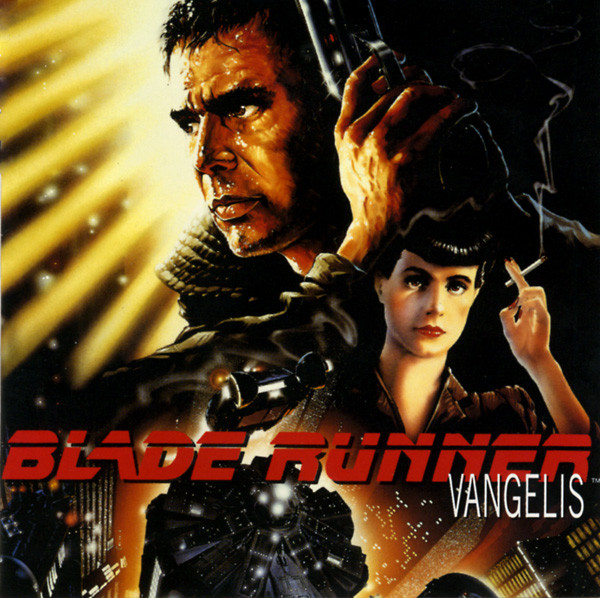
Bladerunner OST – Vangelis – Released June 6th 1994, East/West Records
Bladerunner OST is the official Vangelis soundtrack album to the 1982 scifi classic, Bladerunner.
Despite the huge success of the movie, and the critical acclaim Vangelis’ score received, the actual soundtrack release was inexplicably delayed for 12 years.
As is often with these types of stories, Vangelis blamed the studio for trying to rush release a shoddy product, and the studio blamed Vangelis for being difficult.
As a result, the movie went on to become one of the top era-defining science fiction movies ever made, while the accompanying OST album experienced countless delays.
Hats off to Warner Brothers for managing that rarest of feats, a project that languished in development hell after the movie’s successful release – and a massively successful genre film at that.
Bladerunner is a cinematic masterpiece, without a doubt Ridley Scott’s finest hour and, thanks to its pioneering practical effects work, it still looks spectacular today. Vangelis’ score helps to further elevate the experience and remains one of the finest movie scores ever recorded.
The actual OST album, however, was a huge disappointment to many, mainly because it wasn’t really a proper score, but rather a curated selection of music from the movie interspersed with snippets dialogue, plus some extra bits which weren’t in the movie.
Personally, I was never a huge fan of the use of dialogue in the 1994 OST, I’d much prefer hear the music on its own so I can close my eyes and soar away in my own little imaginary hovercar.
And, while some fans were delighted to finally get a chance to listen to this great music on their stereo, others lamented the numerous Vangelis’ compositions still missing from the OST album.
After waiting 12 years, fans deserved better.
In the end we ended up having to wait a quarter century before getting a release more in line with our expectations, the 2007 25th Anniversary release.
Honestly, I’m just using the fact that it’s 30 years since the release of the original OST as an excuse to talk about Bladerunner. Specifically, how the movie in general helped to shape an entire generation’s vision of the future. And the profound effect the movie’s audio/visual aesthetic, and Vangelis’ score in particular, had on music production from the 1980s onward.
Germany’s Harald Blüchel, better known as techno/trance producer Cosmic Baby, summed it all up in the liner notes of his 1994 A Tribute To Bladerunner release, recounting the time he first saw the movie as a youth and being mesmerised.
Watching that futuristic world on the big screen had profound effect it had on him, and an entire generation of artists and musicians.
Bladerunner’s influence is palpable throughout a range of electronic music of pioneers, including everyone from Juan Atkins to LTJ Bukem.
Samples abound, especially throughout the 90s in tracks from Future Sound of London and UNKLE, as well as drum n bass artists like DJ Trace and Dillinja.
Even Belfast hard rockers Therapy? include samples of Brion James’ character Leon on their 1992 album Pleasure Death. As does Bristol triphop icon Tricky, on the track Aftermath, from his 1995 debut Maxinquaye.
While, more recently, UK electro producer Kurt Baggaley released an entire album of Bladerunner-inspired music, loaded with samples from the movie, on his 2022 Space One album, Tears In The Rain.
And that’s before we even mention how deeply this movie permeated electronic music by singlehandedly defining the neon-noir cyberpunk aesthetic.
Since Bladerunner’s hypersaturated contrast between the brooding dark skylines and eyeball-scalding neon is, in itself, the very essence of techno.
LA 2019
Ok so admittedly the movie’s vision of LA, with its giant smokestacks, flying cars, Pan Am blimps and ubiquitous Atari adverts wasn’t quite as accurate a depiction of 2019 as we thought it was in the 80s, but at least the music still sounds futuristic.
It’s just unfortunate that, on the 1994 OST version, instead of featuring instrumentals the studio decided to overlay dialogue on top of much of the compositions.
I mean, with all due respect to Harrison Ford – you were like a cool big brother for our whole generation – stfu and let us enjoy the music!
And this is the problem right from the get-go. Instead of being able to enjoy that majestic opening music on its own, we get dialogue and sound effects from a completely different scene heaped up on top of it, spoiling the overall effect.
Track two, Blush Response is another standout piece. But again, it’s quite frustrating having all the dialogue poured over the top of it. I know the movie off by heart at this point so I don’t need any reminders of the dialogue.
Incidentally this piece was also sampled by DJ Trace on the track The Beacon.
Rachel’s Song is one of the more pivotal pieces from the album and mercifully, it’s allowed to play through without any dialogue heaped on top of it.
The track was famously sampled by Future Sound Of London on the 1997 track My Kingdom, taking snippets of the choral elements and combining it with Ennio Morricone to create their own desolate cyberpunk masterpiece.
Bladerunner Blues is without a doubt one of my favourite pieces of electronic music ever recorded and is the one piece which, I believe, perfectly encapsulates the style and tone of the movie.
It somehow manages to be futuristic and machine-like, yet equally soulful and deeply melancholic – it’s the sound of a dark, heaving city of broken, lonesome androids crying their caustic tears into the rain.
While many synths were used by Vangelis for Bladerunner, the centrepiece of this entire soundtrack is the iconic Yamaha CS-80 synthesiser, a hulking big behemoth of a machine known for its vast weight, mercurial temperament and remarkably expressive depth and tonality.
No mere electronic device, this was a true instrument one could play with feeling and expression, much as you would a piano. And Vangelis was the instrument’s finest virtuoso.
Worth mentioning, as an aside, when asked to record the soundtrack for Bladerunner 2084, Hans Zimmer insisted on using a similar setup to match Vangelis’ style as faithfully as possible.
During interviews he also took the opportunity to proclaim his love for the temperamental Yamaha CS-80, despite his original model’s predilection towards spontaneous self-combustion. (While the 2017 follow-up Bladerunner 2084 was a rare swing and a miss for Denis Villeneuve, I gotta say Zimmer done a bang-up job on the score.)
On the surface, Bladerunner’s visual tapestry of colossal megastructures and flying cars was way off the mark. But in many other ways, the mood of the movie was spot on.
There’s a pervasive sense of alienation and anxiety from start to finish, amped up by a chaotic explosion of technological excess. Corporate power is all-pervasive, ecological collapse seems inevitable as, all the while, an increasingly diverse range of cultures struggle to survive on a rapidly shrinking planet.
Sound familiar?
The society of Bladerunner is a volatile cocktail of technophobia and ethnic tensions, something which Vangelis conveys magnificently.
The highflyers soar across the skies on sweeping chords and bright neon melodies, but the lower down the social and sonic strata of Bladerunner you get, the less pristine and electronic things become.
The music at street level is a heaving bustle of noise, a clash of cultures, customs and cadence. Where the traditional runs headfirst into the technological, with Oriental kabuki punks and hazy Arabian nights filled with hookah smoke and snake-charming synthesizers.
One of the best examples of this is Tales of the Future, the sound of a cramped and claustrophobic dystopia where hundreds of years of history are busily unravelling all at once. This is the sound of 21st century future shock and it’s more relevant now than ever.
End Titles, often referred to as just the Bladerunner Theme, is perhaps the most influential movie theme in the entire history of electronic music. Not only does it perfectly encapsulate the themes and tone of the movie itself, it’s also an incredible piece of music in its own right.
Which is why so much of dance music, in particular genres like techno and trance, can trace its lineage back to this one piece.
The combination of analogue synths with orchestral instruments is what lends the piece its gravitas, though the true powerhouse of this track is its arpeggiated bassline.
And you can still hear echoes of it to this day, with Laurent Garnier giving not one, but two nods to the maestro on his last album, 33 tours et puis sen vont.
Even more impressive is the technology. It’s easy to forget this music was recorded all the way back in 1982, when electronic music was still very much in its infancy.
Bladerunner’s soundtrack predates the invention of MIDI, for example, which meant sequencing and synchronising the various synths was considerably more difficult than it is today.
Which is perhaps partially why Vangelis wasn’t keen on rushing the soundtrack, since wrangling temperamental machines like the aforementioned CS-80 in a pre-MIDI environment can’t have been easy.
Tears In The Rain is final track named for the unforgettable scene where Rutger Haur’s character Roy Batty gives his dying speech about the futility of our fleeting existence.
It’s the very beating, non-human synthetic heart of the movie and one of the greatest monologues in movie history.
And as expected, the accompanying music from Vangelis is equally poignant, returning full circle, in a sense, by reincorporating the same melodies we encountered in the movie’s explosive opening sequence, but whereas before they sounded robust, now they gentle tinkle like a delicate chandelier.
The light that burns twice as bright…
This was a difficult one to review because I had trouble separating the quality of Vangelis’ score from the actual 1994 soundtrack album and midway through decided there’s no point trying.
The score is one of the greatest pieces of cinematic music ever recorded, easily up there with the likes of Bernard Hermann, John Barry, John Williams and Ennio Morricone.
But if you ask me, even those greats couldn’t deliver a score that so perfectly encapsulates the mood and themes of a movie as perfectly as the Vangelis’ Bladerunner score does.
However, we also need to address the Atari billboard in the room – i.e. the 1994 OST album, which was delayed for over a decade and ultimately ended up disappointing fans.
This isn’t just a perfect example of a company standing in front of an open goal and hesitating. It may also be the worst own goal in history.
The studio asserts the delay was down to Vangelis being difficult – as though a Greek with an artistic temperament could ever be that.
Vangelis has always asserted that he wanted more time to complete the soundtrack and do it properly. But the studio didn’t want to do that.
So instead, they rushed out an orchestral cover album, based on Vangelis’ compositions but featuring none of his original recordings. Fans weren’t happy.
What followed was a 12-year impasse before the release of the OST. Once again, fans weren’t happy. In the end we had to wait a full quarter century before we got the soundtrack we wanted. (The aforementioned extended edition.)
But then what else can you expect from Bladerunner? This is a movie which currently has seven different versions and counting, including those with the terrible narration sections the studio insisted on.
Considering all the moronic meddling studios do on a regular basis, thwarting the creative process at every turn, we should consider ourselves lucky Bladerunner exists at all.
The far-flung future of 2019 may have come and gone since, but Bladerunner remains one of the greatest scifi movies of all time with a message which still resonates today. And, though we had to wait far too long to get the full soundtrack in its purest form, Vangelis’ score remains timeless.
In fact, I’m struggling to think of an example where the score which so perfectly fits the movie it becomes a character onto itself.
Also, I think I know what I’m going to watch again tonight…