
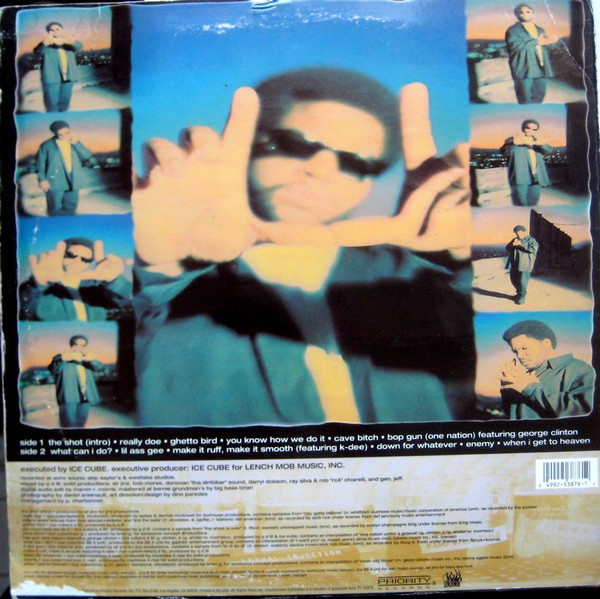
Lethal Injection – Ice Cube – Released December 7th, 1993
In December 1993, west coast rapper, actor, director and all-round fucking legend Ice Cube released his fourth solo album, Lethal Injection.
Ice Cube had already released three hit albums by the time his fellow NWA cohort, Dr Dre, released his debut, The Chronic, in December 1992.
By the time Lethal Injection was released, almost exactly a year later, it was clear that Ice Cube had pivoted musically. The Chronic and Snoop Dogg’s Doggystyle, released a month previous, had since made g funk the definitive west coast sound, so Cube got on board quickly.
But, rather than being outdone by Dre and Snoop Dogg, Cube sought to remind the world why he’s top dog by going after the one and only atomic dog.
After all, why sample George Clinton when you can straight up jack George Clinton or, better yet, maybe just ask him nicely first if he’d like to go in the studio and record the result – which is exactly what Cube did.

But for anyone who might think that Ice Cube was jumping on the bandwagon, listen back to his pre-Chronic catalogue of music and you’ll hear plenty of Parliament and Funkadelic in there, along with samples of other p funk classics like Ohio Players’ Funky Worm.
Course I knew none of this at the time. I got into hiphop initially because I liked the sounds – the beats and the scratches – so I was mainly into instrumental stuff like Bomb The Bass’ Digg Dis.
My first successful attempts at penetrating rap lyrics beyond just surface level skimming came via Public Enemy which proved hugely rewarding.
But the first hiphop artist to ever make a real impact on me was Ice Cube. That’s when I went from, “yeah this stuff’s pretty cool”, to “wow I fucking LOVE this shit!”
The catalyst was a discussion with a kid at school which lead to me receiving a double-sided cassette tape with Death Certificate on one side and Predator on the other.
I popped the tape in, pressed play – and was instantly hooked.
Everything was so well thought out, the lyrics, the samples, the scratches, the clever snippets of movie dialogue, it all fit together so perfectly and every relisten taught me more and more.
There I was, just 13 years old growing up in Ireland, hearing tales about drive-bys in Missouri and gradually puzzling out what a nappy dugout was.
Death Certificate and Predator are two of my favourite hiphop albums of all time (topped only by the Wu Tang’s 36 Chambers.)
Lethal Injection is a fine follow-up to these two albums, and though I don’t think it has that same lightning-in-a-bottle effect as some of Cube’s previous work, it nonetheless still contains some of his finest tracks while oozing with sleazy, west coast gangsta flava.
Make It Smooth
The first tune, Really Doe, brings that boom-bap swagger straight out the box with a hook from Rose Royce, plus the Pointer Sisters, Loletta Holloway and Slick Rick all in tow.
Though this album saw a new roster of producers, it’s still got all the same hallmarks of previous productions, using disparate samples and smushing them all together in new and interesting ways.
It’s one of the things that Ice Cube does best, though the man has many talents. His main talent, however, is his ability to create a diss track or tell a story with a killer hook all based around a single angry metaphor.
Track two, Ghetto Bird, is a masterclass in how to do this, with the focus of Cube’s ire in this instance being the constant nuisance of police helicopters.
In the story Cube’s trying to evade capture with the relentless ghetto bird on his tail, he gets off the streets but still hears it in the distance; “all that night I heard the bird circle, while I was eating fish and watching Erkle.”
At least he gets his end away though. (Fuck the ghetto bird!)
Ghetto Bird is the first of four tracks produced by QDIII and also features that ubiquitous Funky Worm sample which he used the previous year on Wicked, not to mention featuring in the NWA track Dopeman).
Really doe, you gotta live Cube’s flair for weaving metaphors and telling stories. In the O’Shea Jackson book of ornithology, a bird can be helicopter or it can be a kilo of cocaine (worth more than a Bush), he truly is the master of street allegory.
But even when he’s not telling a story he still paints a vivid picture.
You Know How We Do It is one of my all-time favourite summer songs and is up there with Gin and Juice as one of the definitive g funk tracks. It features a bassline via Evelyn “Champagne” King elevated further with warm sprinkle of Summer Madness.
And it always brings a smile to my face when I hear it.
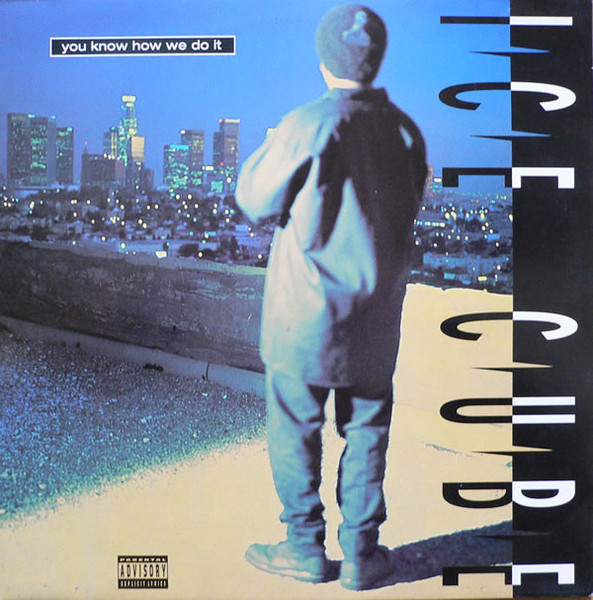
There’s no real story to this one, it’s more about just chilling out, hanging out with the guys and talking shit yet it’s so vivid you can smell the bud, taste the Hennesy and feel the sun on the back of your neck even while growing up in a country that gets a maximum of seven days sunshine a year.
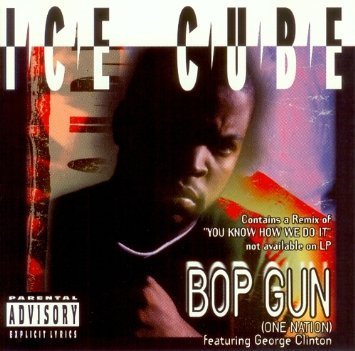
Cave Bitch is a diss track aimed at white groupies and the man doesn’t hold back, to put it mildly, but lets be honest, we all want to get to the next track don’t we? Bop Gun, featuring George Clinton.
This one plays like a greatest hits tribute to the p funk legend while the chorus comes straight from the Funkadelic track One Nation Under A Groove.
It could have easily been dismissed as a cynical ploy to jump on the g funk bandwagon, but for the fact that the pairing of Cube and Clinton clicks together seamlessly and the result is so damn funky.
The album version stretches out to over 11 minutes, a long time for a 90s rap track (though fairly short by p funk standards.) For the sake of nostalgia, though, here’s the original 1994 music video from the single release, which was played almost incessantly that summer and, if you look closely, you’ll see a cameo by Bootsy Collins.
Track 7, What Can I Do?, takes its musical cues from Marvin Gaye while Cube tells the story about the ups and downs of the crack game. He starts off as a crack slinger who comes up from the streets to make it big only to be sent to prison.
When he comes out the game is changed, no more crack game, he’s forced to try and go straight and the option that’s left is the Big Mac game, “welcome to McDonalds may I please help you?”
Lil Ass Gee continues this theme, in some ways both tracks remind me of Dre’s Little Ghetto Boy, similar stories, similar inevitable trajectory.
Both What Can I Do and Lil Ass Gee would later receive the remix treatment on Cube’s next album, Bootlegs and B Sides. (Really looking forward to writing about this one too.)
While the remix doubles down on the g funk sound, the original 1993 Lethal Injection version, produced by longtime Cube collaborator Sir Jinx, sounds like it could have come straight from either Predator or Death Certificate.
The lyrics see Cube taking a swipe at young kiddy gangsters, trying to prove their manhood before they’re fully grown. It’s classic Cube this one, as I said, few if any can match his ability to write a diss track that also tells a compelling story.
Make It Ruff, Make It Smooth is another slow-burning head-nodder while Down for Whatever is a proper slice of dirty g funk sleaze.
After that comes Enemy, another diss track aimed at white America though it pales (pun intended) when compared to older tracks like Horny Little Devil and I Wanna Kill Sam.
So for me this one’s filler, then again maybe it’s lost on me since my knowledge of self is sketchy and I technically fall under the cracker demographic.
Which brings us to another Ice Cube talents, his ability to court controversy by talking some seriously incendiary shit. Not that we cared in Ireland at the time.
Near’s I can tell the only issue we seemed to have with Cube’s lyrics was when Cube’s mamma cooked him breakfast with no hog and he was happy about it, given that your average Irishman will always opt for a greasy fry-up over Farrakhan any day of the week.
But we listened none the less and I’d like to think Cube helped reshape our generation’s eating habits and perhaps even saved some of us from dying of heart attacks before the age of 30.
“No rashers and sausages diss mornin’ mammy, I’m on the wesht coast diet.”
When NWA shouted Fuck The Police, we were down too but we also adored the fact that Ice Cube, “dissed the pope more times than Sinéad O’Connor.”
So the closing track, When I Get To Heaven, that shit definitely clicked.
This time Cube puts organised religion in his crosshairs. It’s not an angry diss track, more a sense of eye-rolling contempt backed with a slower, introspective beat and samples from Marvin Gaye.
It’s also a brilliant choice of track to end the album.
In many ways it’s similar to KRS-One’s Higher Level from Return of the Boom Bap. Both albums ending on similar notes, with identical themes, both released within months of each other.
Coincidence or tapping the zeitgeist? I prefer to believe the latter.
Classic Cube
Lethal Injection is Ice Cube at the top of his game.
It’s not his best album (for me that’s Predator) but it’s certainly his last great album.
Sadly we had to wait another five years for his next proper album (not including Bootlegs and B Sides, which was also solid but technically more of a remix compilation) by which point the general consensus was that Cube had “gone Hollywood.”
Sure, Friday’s a classic and I’ll never not watch it when it comes on TV, and, but there “ain’t no fucking motion picture” that can compare with the intense imagery Ice Cube projected into my mind as a yoof.
We still got glimpses of that same magic, of course. Later tracks like The Nigga Trap and Gangsta Rap Made Me Do it are up there with some of his best, since they showcase his penchant for lyrical gut-punches and enthralling storytelling.
I know, I keep coming back to this point don’t I?
But there’s a reason for it.
Through Ice Cube we learned about life in a place some thousands of kilometres (and at least 30 degrees-plus Celsius) distant, about experiences more distant still, but through his lyrics, he brought those frustrations home.
We didn’t live those experiences – how could we? – but certainly we felt them. It wasn’t just entertainment, we were also being educated about the real America.
And yet ironically, Ice Cube’s rise to fame is the embodiment of what the American Dream is supposed to be, driven by hard work, determination and a staggering amount of raw talent.
It took me 31 years before the fates finally afforded me the chance to see him live at a gig in Dublin last weekend, with Cypress Hill as the warm-up act. (Which says it all right there.)
You might be forgiven for thinking that Cube’s gone old and soft and can’t still bring it and you’d be dead fucking wrong.
Ice Cube is the man who got me properly into hiphop and, as such, remains my favourite rapper to this day. But I’ll admit I was one of the doubters (worst case scenario I knew from experience the ‘Hill would bring it) and I vow to never doubt the man again.
Cube even alluded to this at the gig, “y’awl came to hear Cypress Hill huh?”
It’s rare to hear hiphop legends being self-deprecating, but Cube strutted out to address the punk-ass pachyderm in the room without fear, knowing full well what we were all thinking, that these days he cares more about Hollywood movies and basketball than hiphop, “you’re all wonderin’ – can Ice Cube still bring it?”
Before preceding to demolish the fucking place.
Included in the repertoire were a few choice classics from this album, including Bop Gun and Ghetto Bird. I also got nice hazy memories of dancing to You Know How We Do It while rapping along quietly with a big cheesy grin on my gob.
I’ve been a fan of Ice Cube since my early teens and now I’m a middle-aged man. Ice Cube’s even older still, by a full decade, but he still busts rhymes with the same gusto he delivered way back in the day.
So don’t ever doubt it – the man can still bring it.